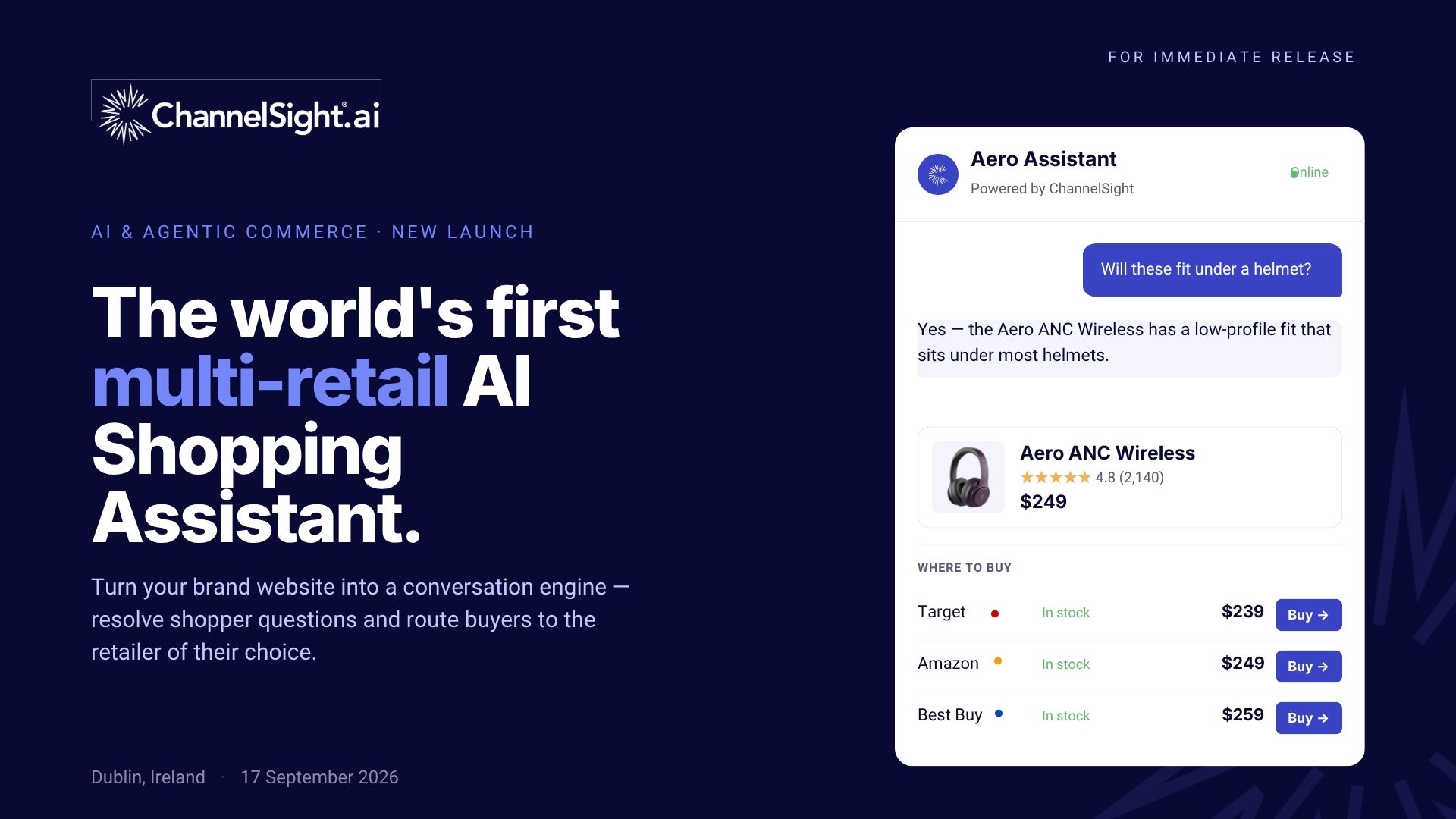
Inside ChannelSight’s Conversational Commerce Assistant
Someone shopping for a laptop for photo editing usually knows that they need a laptop.
What they may not know is whether 16GB or 32GB of memory will materially affect performance, how much dedicated graphics capability matters, whether display quality should trump portability, or which compromises they are making by choosing a lighter machine.
They can describe their desired outcome easily:
“I need a laptop for editing high-resolution photos. I travel regularly, so it cannot be too heavy, and I would prefer to spend less than €1,500.”
Most ecommerce sites can filter by processor, memory, storage, screen size, weight and price. Those filters are useful, if the consumer already understands which specifications matter.
Conversational commerce changes that starting point. Instead of asking the consumer to translate their needs into technical attributes, it lets them describe the outcome first. That sounds simple but making it work well isn’t.
A language model can understand the request and generate a convincing answer. The harder problem is determining which products actually satisfy it, which exact configurations are valid, whether those products are approved by the brand, whether they are available in the relevant market, and where they can be purchased.
That is where ChannelSight’s existing commerce infrastructure becomes critical.
The language model helps interpret what the consumer says, then ChannelSight’s commerce intelligence layer determines what is commercially true.
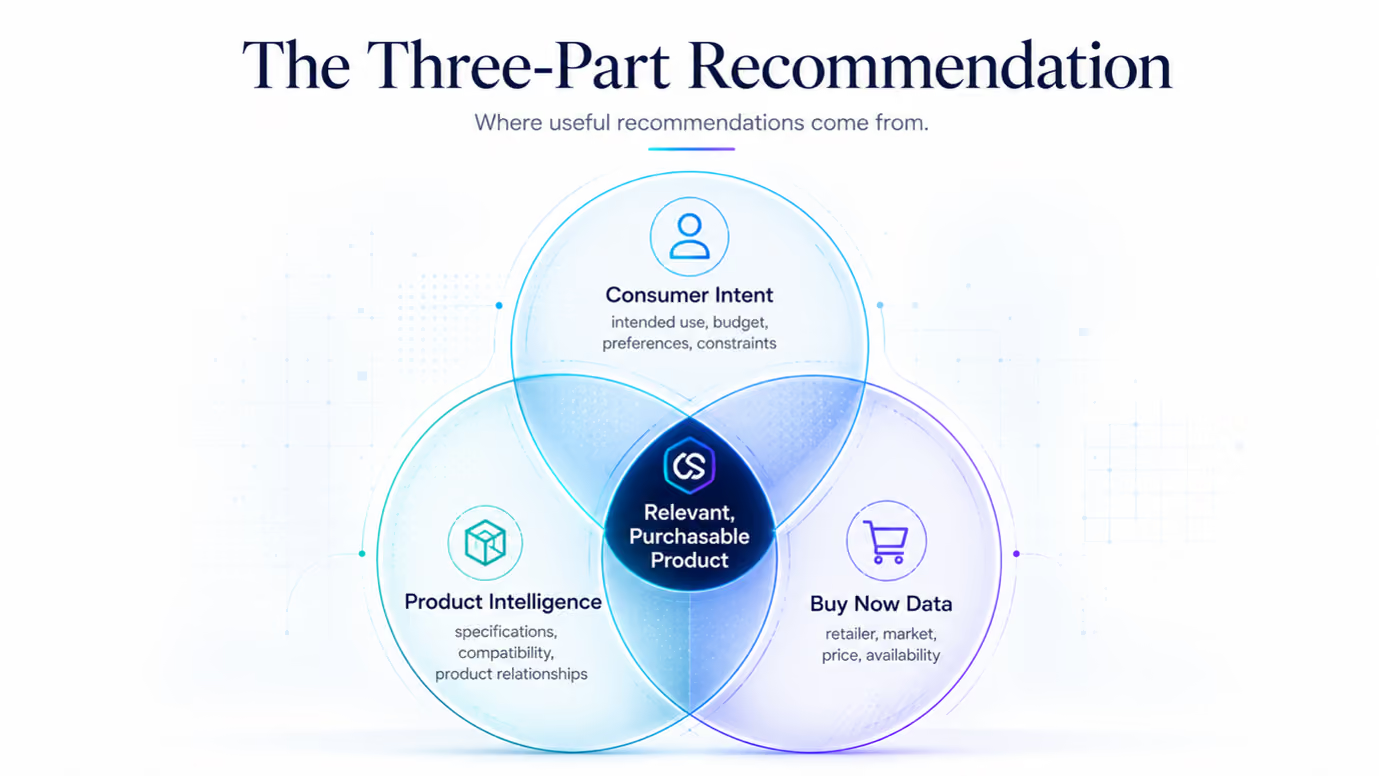
A successful conversational commerce journey depends on bringing together three different kinds of information.
The first is consumer intent: what the shopper is trying to achieve, the constraints that matter, and the trade-offs they are willing to make. In the laptop example, that includes photo editing, weight and a maximum budget.
The second is product intelligence: the specifications, attributes and product relationships needed to work out which products can actually meet those requirements. For photo editing, that may include memory, processor performance, display quality, storage capacity and battery life. The consumer doesn't need to know those terms in advance but the system does.
The third is Buy Now data, where suitability meets commercial reality.
A technically suitable laptop is of little value if the exact configuration can't be purchased in the consumer’s market, or if the retailer listing points to a different model, storage capacity or generation.
The strongest recommendation sits at the intersection of all three: it fits the consumer’s need, satisfies the relevant product criteria and connects to a valid path to purchase.
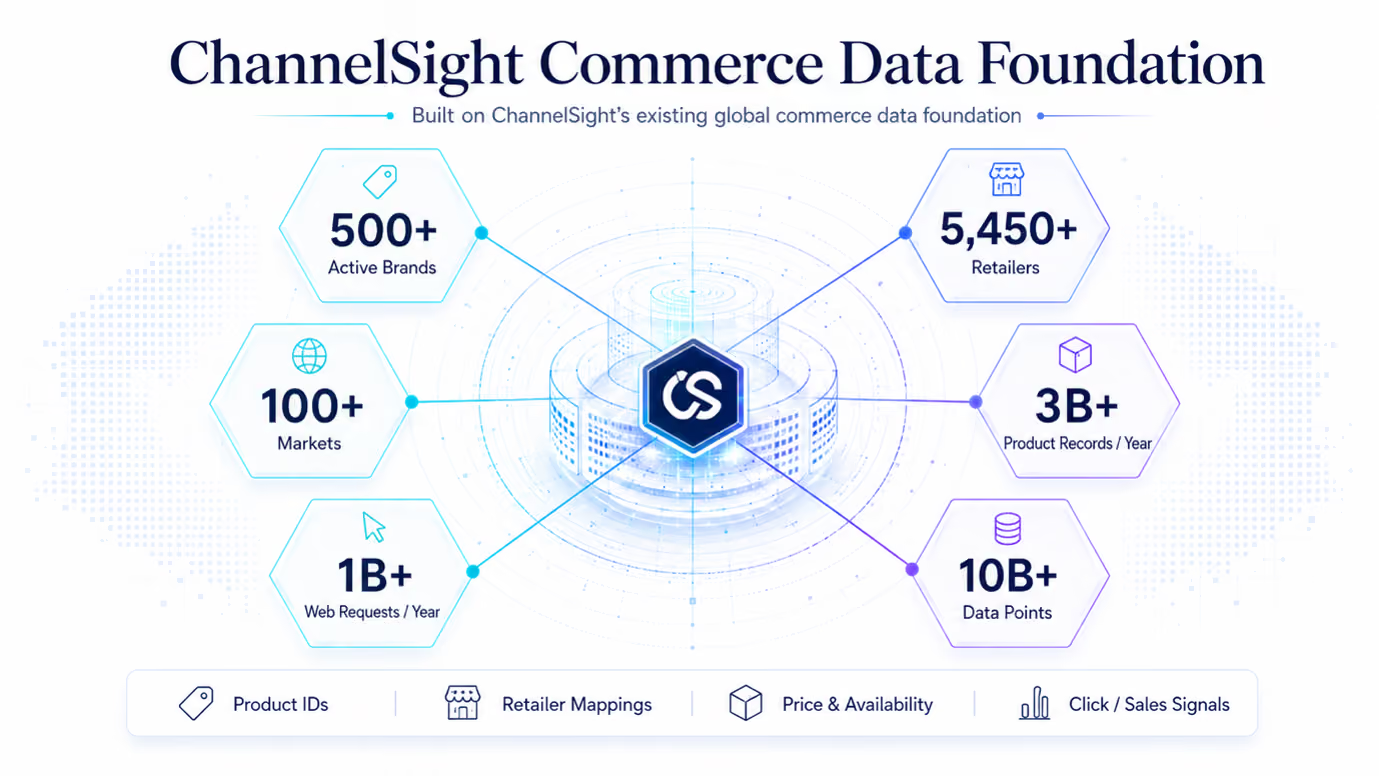
This is a natural extension of what ChannelSight already does. Our Buy Now technology operates across product identifiers, brand catalogues, retailer relationships, product-to-retailer mappings, pricing and availability data, market coverage and downstream performance signals.
Conversational commerce brings those capabilities into the decision process earlier.
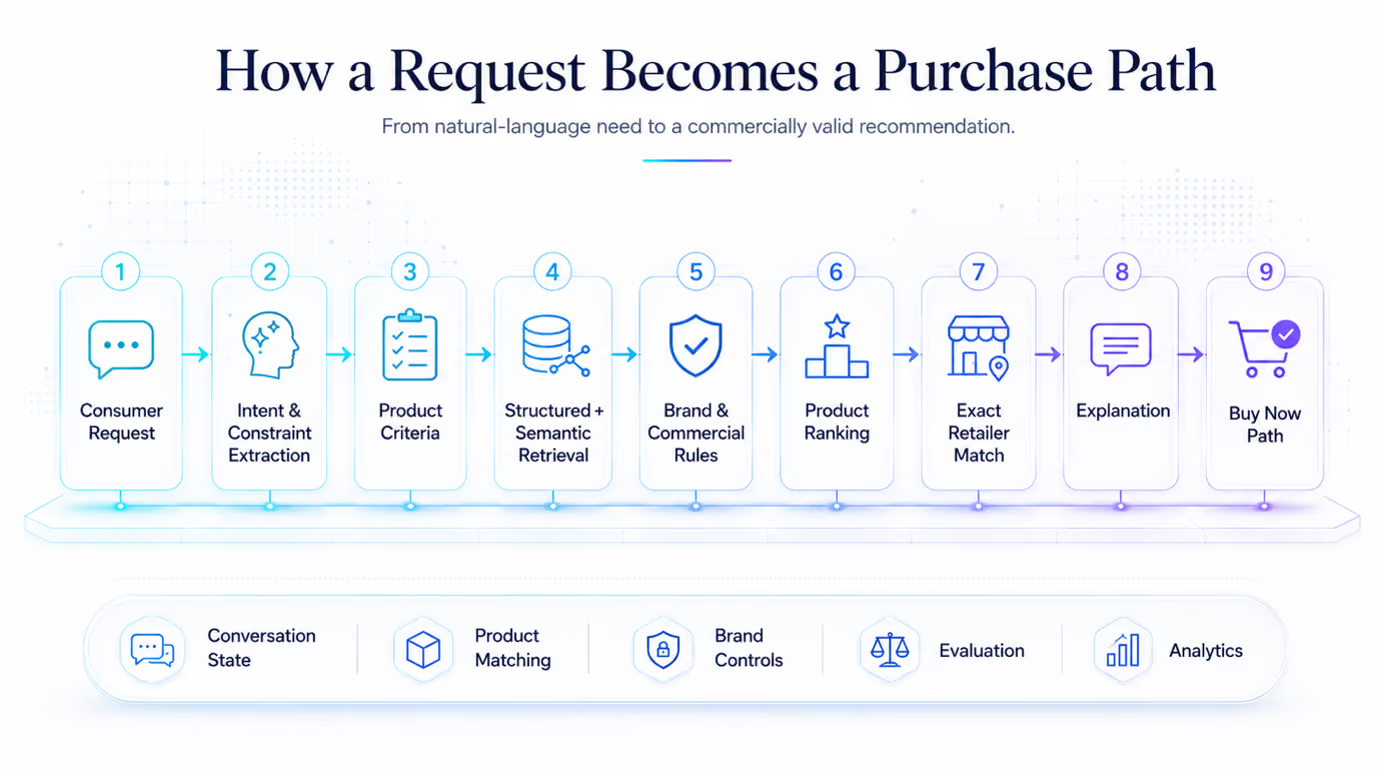
How ChannelSight turns a conversation into a recommendation
The consumer should not have to understand the catalogue structure before they begin.
Someone might say:
“I need something for editing photos, but I travel regularly and don’t want anything too heavy.”
That sentence contains useful information, but it is not yet a product specification.
The first job is to separate hard constraints from softer preferences and identify what is still unknown. A budget may be fixed. Low weight may be important but flexible. Display quality may matter a great deal for photo editing, even if the consumer hasn't mentioned colour accuracy or panel type.
The next job is to translate ordinary language into product criteria.
Some requirements map neatly to structured fields, for example - price, weight, screen size or storage capacity. Others require category understanding. “Good for editing photos while travelling” is not a catalogue attribute. It is a combination of use case, performance needs and trade-offs.
ChannelSight combines structured filtering, keyword matching and semantic retrieval to build a shortlist. The system can then apply rules that the language model is not allowed to override, such as approved catalogue status, mandatory specifications, product compatibility, budget limits, market restrictions, retailer eligibility, discontinued products and other brand-specific controls.
Only then are suitable products ranked.
Remember that our primary intention is to bring the user to a suitable product and drive a conversion as quickly and frictionlessly as possible. As a result, we don’t seek to expand the layers of questioning where it may add excessive discussion and cause the user to become bored or frustrated – we filter, then direct to a purchase as soon as we have confidence that a suitable product fit has been identified.
The final check is equally important: resolving the exact product and retailer listing.
A 16GB laptop and a 32GB version may have almost identical retailer titles. The same product family may have several generations, regional variants or accessory bundles, so a superficially similar match can lead to a commercially incorrect recommendation.
ChannelSight’s product-matching capability is designed to resolve those distinctions before a Buy Now option is shown.
The consumer-facing explanation comes last. The model can explain why one product was selected, what the principal trade-off is and what alternative might suit a different preference.
It is not being asked to decide what is true from scratch.
Why this is difficult to replicate
Product recommendation becomes much harder when the answer has to be both useful and commercially correct.
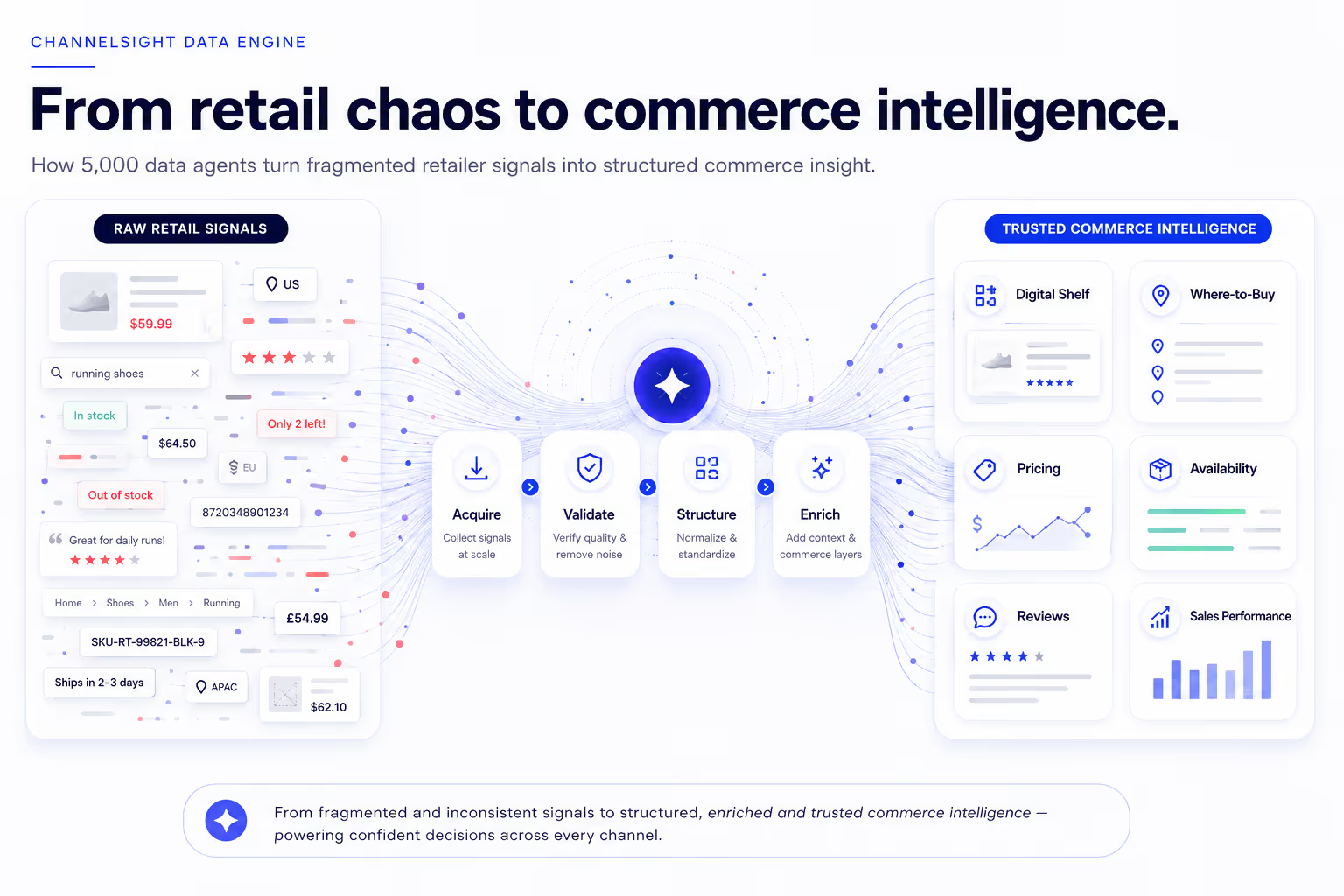
Product information rarely arrives in one clean, consistent format - attributes can be incomplete, units differ, the same product may be named differently across markets, retailer titles can omit important identifiers, and variants, bundles and accessories can look almost identical to the main product.
Those problems are familiar to ChannelSight because we've spent more than a decade solving them.
Our existing commerce data foundation includes brand catalogue information, product identifiers and relationships, localised retailer products, product-to-retailer mappings, market coverage, pricing and availability information, and historical sales performance.
The important point is not simply the volume of data but the relationship between those datasets.
A retailer price has limited value if the product match is wrong. Availability has limited value if it refers to a different configuration. Consumer click-out behaviour has limited value if it cannot be tied back to the correct product, retailer and market.
ChannelSight’s advantage comes from joining these elements together. That makes it possible to move beyond a plausible recommendation and towards a validated one.
Control, accuracy and enterprise operation
For brands, this can't be a black box.
A conversational experience needs to operate inside a defined commercial environment. Brands may need control over which products are eligible, which content sources can be used, what claims are approved, which retailers appear, how market-specific ranges are handled, and when the system should ask for clarification rather than make a recommendation.
A model can recognise that the shopper is looking for a lightweight machine for photo editing. It should not be allowed to quietly ignore the consumer’s budget, recommend a discontinued product or invent an unsupported product capability.
The same principle applies to evaluation.
We're not interested only in whether the conversation sounds natural. The system needs to be tested against realistic buying scenarios: did it understand the hard requirements, select the correct configuration, respect product and market rules, avoid unsupported claims and produce a valid retailer path?
Because the architecture is model-agnostic, different models can also be evaluated for different tasks. A lightweight model may be perfectly adequate for extracting structured requirements from a sentence. A more capable model may be preferable when comparing closely matched products or explaining a nuanced trade-off.
ChannelSight’s orchestration and commerce intelligence services run on enterprise-grade Azure infrastructure, with Azure AI Foundry supporting model evaluation and deployment, and Azure AI Search supporting elements of retrieval. Those technologies matter, but they're not the source of the differentiation.
The differentiation lies in the commerce knowledge, matching capability, controls and data that sit around them.
The system also has to work economically at scale. Model calls, retrieval and conversational state introduce cost and abuse considerations that don't exist in the same way for a conventional Buy Now widget. Rate limits, session budgets, caching, model routing, bot protection and operational controls are therefore part of the architecture from the outset.
A new source of consumer intelligence
There is another important benefit. Traditional analytics can tell a brand which pages consumers visit, which filters they use and which products they click.
A conversation can reveal more detail on the process leading from consumer need to product purchase and provide a valuable source of intent intelligence – key product attributes that cause uncertainty, where product information fails to answer key queries, and so on.
Over time, those signals can help improve product content, catalogue enrichment, product detail pages, category education and the recommendation experience itself.
The journey therefore creates a useful feedback loop: better product intelligence supports better recommendations; better recommendations create more completed journeys; those journeys provide better insight into what consumers actually need.
Why this matters for brands
Traditional Buy Now technology answers an important question:
“Where can I buy this product?”
Conversational commerce allows brands to participate one step earlier:
“Which product is right for what I need?”
For categories where consumers face complex ranges, unfamiliar specifications or meaningful trade-offs, that's a significant opportunity.
Brands can help consumers discover the right product earlier, surface products that might otherwise be overlooked, keep recommendations within approved commercial rules and connect the decision directly to a measurable retailer journey.
And because the experience sits on top of ChannelSight’s existing commerce infrastructure, the conversation doesn't end with an AI-generated answer - it can end with a product the consumer can actually buy.
Conversational commerce is not simply about making product discovery feel more natural, it's about combining natural-language understanding with product intelligence, retailer data and commercial controls well enough to make the resulting recommendation useful, trustworthy and actionable.
Done properly, the technology should feel simple to the consumer - the complexity belongs underneath.
For brands, the opportunity is to extend the Buy Now journey beyond “Where can I buy this product?” to help answer the question that often comes first: “Which product is right for me?”
That's what we're building at ChannelSight.
We're now working with brands to explore where Conversational Commerce can add most value across their product ranges and consumer journeys.
If you're interested in seeing the technology in action, or in exploring how it could work for your own catalogue please get in touch.